

-
Château Lagrange 2015
Bottle 75 cl · Wooden case of 12
Regular price €676,80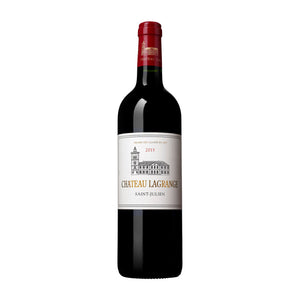
Bottle 75 cl · Wooden case of 12
€56,40 per bottle
€676,80 -
Château Lagrange 2016
Bottle 75 cl · Wooden case of 12
Regular price €648,00
Bottle 75 cl · Wooden case of 12
€54,00 per bottle
€648,00 -
Château Lagrange 2018
Bottle 75 cl · Wooden case of 12
Regular price €561,60
Bottle 75 cl · Wooden case of 12
€46,80 per bottle
€561,60 -
Les Fiefs de Lagrange 2017
Bottle 75 cl · Wooden case of 12
Regular price €295,20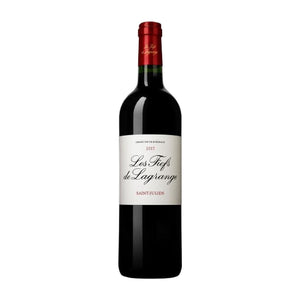
Bottle 75 cl · Wooden case of 12
€24,60 per bottle
€295,20 -
Les Fiefs de Lagrange 2018
Bottle 75 cl · Wooden case of 12
Regular price €309,60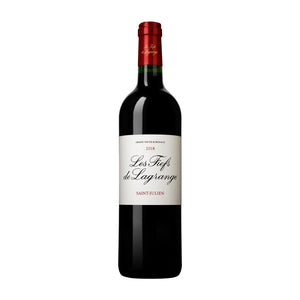
Bottle 75 cl · Wooden case of 12
€25,80 per bottle
€309,60


Saint-Julien · 3rd classified growth in 1855
Two wines, one estate
Same estate, same team, two uses.
Château Lagrange
The grand vin. Predominantly Cabernet-sauvignon, with Merlot and a touch of Petit Verdot. Over one hundred hectares to the west of the appellation, far from the river, on two gravelly rises. Ready around eight years, it keeps for twenty-five years in good vintages.
Les Fiefs de Lagrange
The second wine. Ready around three or four years, at half the price of the grand vin: a Saint-Julien for a large table.
The Japanese Suntory group bought Lagrange in 1983, replanted, and rebuilt the cellars: it is one of the most cited turnarounds in the Médoc. The estate also makes a white, Les Arums de Lagrange, in the Bordeaux appellation. The other châteaux in the appellation are on the Saint-Julien wines page.
One of the two Günzian gravel rises at Lagrange is the highest point in Saint-Julien. The soil is sandy-gravel, the subsoil is clay-limestone. The vineyard is divided into 103 plots, vinified separately in 102 vats, and its boundaries are those that were classified in 1855. The château's technical sheets describe 2016 as an exceptionally hot and dry summer, harvested from October 3 to 27. 2019 yielded the lightest berries observed in 36 years and a record blend of 80% Cabernet-sauvignon. 2020 is the estate's smallest harvest in thirty years, with a tension the winemaker compares to the 2010.
What to serve it with
- Château Lagrange: rack of lamb (which wine with lamb), feathered game for vintages over fifteen years old (which wine with game).
- Les Fiefs de Lagrange: grilled meats, duck breast (which wine with duck), roast poultry (which wine with poultry).
- With cheese: a Comté, an Ossau-Iraty (which wine with cheese).
Which vintage for which occasion
For client gifts, a wooden case of six or twelve of a classified growth is perfect as is: see end-of-year client gifts. For a seminar or team lunch, Les Fiefs, ready to drink. For a birthday, the birth year (birth vintage).
Frequently asked questions
Is Château Lagrange a classified growth?
Yes. It is a third classified growth in the 1855 classification, in the Saint-Julien appellation. Les Fiefs de Lagrange, its second wine, and Les Arums, its white, are not classified.
Château Lagrange from Saint-Julien or Pomerol?
Two châteaux bear this name. The one on this page is in Saint-Julien, a third classified growth of the Médoc. Château Lagrange in Pomerol, on the right bank, is a different estate, with no connection to it. The appellation on the label distinguishes them.
When should I drink a Château Lagrange?
Plan on eight years before opening it, and it will keep well for twenty-five years, a little longer in a great year, a little less in a weak year or in half-bottles; for Les Fiefs, three to twelve years.
Can't find your wine?
The shop shows only part of what we can offer. As a Bordeaux wholesaler, Transvins works with the châteaux and the Bordeaux trade: tell us the wine and vintage you are after, we will look for it and reply with availability and price.